Industry Insights · September 2026
Hinges, Drawer Systems & Handles: A 2026 Sourcing Guide for Cabinet Hardware Buyers
A kitchen or a wardrobe is judged at the hinges. Doors that sigh shut instead of slamming, drawers that glide even when loaded with pans, a handle that feels solid in the hand — these are the details end users notice every single day. They are also the details that decide whether your cabinet program earns repeat orders.
For distributors, importers and kitchen manufacturers, 2026 looks like a year of consolidation. Buyers are narrowing their supplier lists, deepening core ranges and paying much closer attention to specifications — because their own customers now compare hardware in showrooms the way they compare appliances. Hinges, drawer systems and handles sit at the center of that movement: they are the three highest-frequency categories in cabinet hardware, and the three where quality differences are easiest to feel.
This guide covers what to look for in each of the three categories this year, plus the sourcing details — MOQs, lead times, testing and mixed loading — that decide your landed cost. It is written for importers, distributors and manufacturers who compare products across markets, and it is drawn from the ranges and order patterns of a hardware exporter shipping to the Middle East, Central Asia and Southeast Asia every month.
Hinges: the component that decides how a cabinet feels
Hinges are the hardest-working part of any cabinet. A door on a busy kitchen is opened and closed dozens of times a day; over ten years that adds up to tens of thousands of cycles. It is no surprise that hinge quality is the single most common reason a cabinet “feels cheap” — or doesn’t.
Soft-close and hydraulic damping are now the baseline
A decade ago soft-close was an upgrade. In 2026 it is the expectation. Buyers across the Middle East, Central Asia and Southeast Asia increasingly specify soft-close hinges as standard, because a door that closes quietly signals quality the moment a customer tries it in the showroom.
Two product families dominate this shift:
- 110° soft-close hinges with built-in hydraulic damping, sized for standard 18 mm carcasses and tested past 100,000 open-close cycles
- Hydraulic damping hinges in nickel, matte black, brushed brass and custom finishes, for programs that need one consistent look across a whole cabinet range
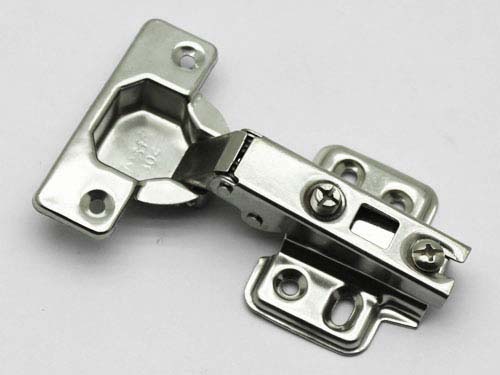
When you compare hinge suppliers, ask for the cycle-test count and the salt-spray hours — not just the price per piece. The difference between a hinge tested to 30,000 cycles and one tested to 100,000 cycles is invisible in a sample box, and very visible in field complaints a year later.
How a hinge is specified matters just as much as how it is built. Before placing an order, agree on five things with your supplier: cup diameter (35 mm is the industry standard), opening angle (100°–110° for standard cabinets, up to 175° for aluminium frames), overlay (full, half or inset), damper type, and base-plate fixing (clip-on or screw-on). Getting these five right prevents the classic error of receiving a container of hinges that “almost” fit.
Heavy-duty hinges for heavier doors
Not every door is a kitchen door. Entrance cabinets, garage storage and workshop furniture carry solid-wood or oversized doors, where a standard cup hinge simply cannot cope. Heavy-duty butt hinges handle that job — thicker leaves, stronger pin assemblies and finishes that resist humidity. For furniture makers, they are the difference between a warranty claim and a ten-year cabinet. For humid and coastal markets, specify stainless steel or heavy plating — standard light plating will not survive the climate.
Glass doors and aluminium frames
Glass and aluminium-frame doors keep growing in retail displays, bathroom vanities and modern wardrobes. These doors need dedicated hardware: clamp-on glass door hinges grip the glass without drilling, while aluminium-frame 175° drill-free hinges install with a clip instead of a drill — a major time-saver for factories that assemble in volume and a cleaner result for installers. Both clamp-on and drill-free families need only a screwdriver to install, which keeps assembly lines moving and reduces breakage — a hidden cost that rarely appears in quotations.
For distributors, stocking a full hinge program — standard soft-close, heavy-duty, glass and aluminium-frame — means every cabinet project in your market can be served from one container.
Drawer systems: slides, boxes and pull-outs
If hinges decide how a cabinet feels, drawer systems decide how it works. Storage remains the number one frustration for end users, and the practical answer is almost always more and better drawers — which makes this the fastest-growing hardware category in most export markets.
Match the slide to the drawer
Slide selection is where most purchasing mistakes happen, because drawer slides look similar on a shelf but behave very differently under load. A simple way to segment your range:
- 3-fold ball-bearing slides — full extension, smooth running, the volume workhorse for kitchen and office drawers
- Undermount soft-close slides — hidden beneath the drawer box, with integrated damping for a quiet, automatic close; the premium choice for handleless kitchens
- Heavy-duty full-extension slides — for tool chests, laundry pull-outs and any drawer that carries serious weight
- Two-fold side-mount slides — the economy option for RTA furniture and entry-level ranges, where price per set matters most
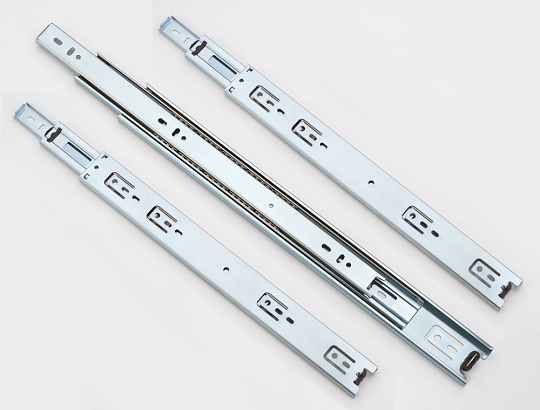
A practical rule when specifying: choose the load class first (20–45 kg light/medium, 30–60 kg undermount, up to 100 kg heavy-duty), then the mounting style, then the length. Suppliers who can quote all three dimensions of choice from stock save you weeks of back-and-forth.
Sizing is the second decision. Slides are stocked in nominal lengths from 250 mm to 550 mm in fixed steps; drawer length plus 10–20 mm of clearance is the rule of thumb, and your supplier should confirm the final size against your drawer drawing before production. Ask also about extension type: 3/4 extension is fine for wardrobe drawers, while full extension is what kitchen buyers expect — and what prevents the “I can’t reach the back” complaints that return orders.
Push-to-open for handleless kitchens
Handleless design continues to spread from premium European kitchens into mainstream projects, and it runs on push-to-open hardware. Push-to-open slides let a handle-free drawer spring open with a light press, while push-to-open latches bring the same behavior to hinged doors that do not need full tip-on hinges. Together with tip-on hinges, these parts let a dealer offer a complete “clean front” option without changing the cabinet program. In practice, push-to-open models are usually paired with damping so the drawer still closes softly — worth confirming when you compare quotes.
Complete drawer boxes and pull-outs
The next step up from slides is the complete drawer system: metal drawer box sets that arrive ready to assemble, aluminium drawer profiles for slim, modern sides that take glass or wood panels, and accessories that turn a deep cabinet into usable storage — under-sink pull-out baskets and drawer organizer inserts.
These products carry higher unit prices but also higher margins, and they upgrade the perceived quality of every cabinet they enter. For importers, they are the natural next step after establishing a slides business. Because these systems ship as matched sets — box, runners, clips — they also simplify your warehouse: one SKU per drawer height instead of a dozen loose parts.
Handles and knobs: the fastest way to refresh a range
Where hardware meets design, handles do the talking. They are the most visible piece of hardware on any cabinet, and also the easiest way for a dealer to refresh a range without touching the cabinet box.
The 2026 finish mix is clear:
- Aluminium T-bar handles and U-shape cabinet pulls in matte black, brushed nickel and champagne gold — the modern volume look
- Full-height aluminium handles for a minimal, architectural statement on tall doors
- Zinc alloy cabinet knobs and single-hole round knobs for classic doors and vanities
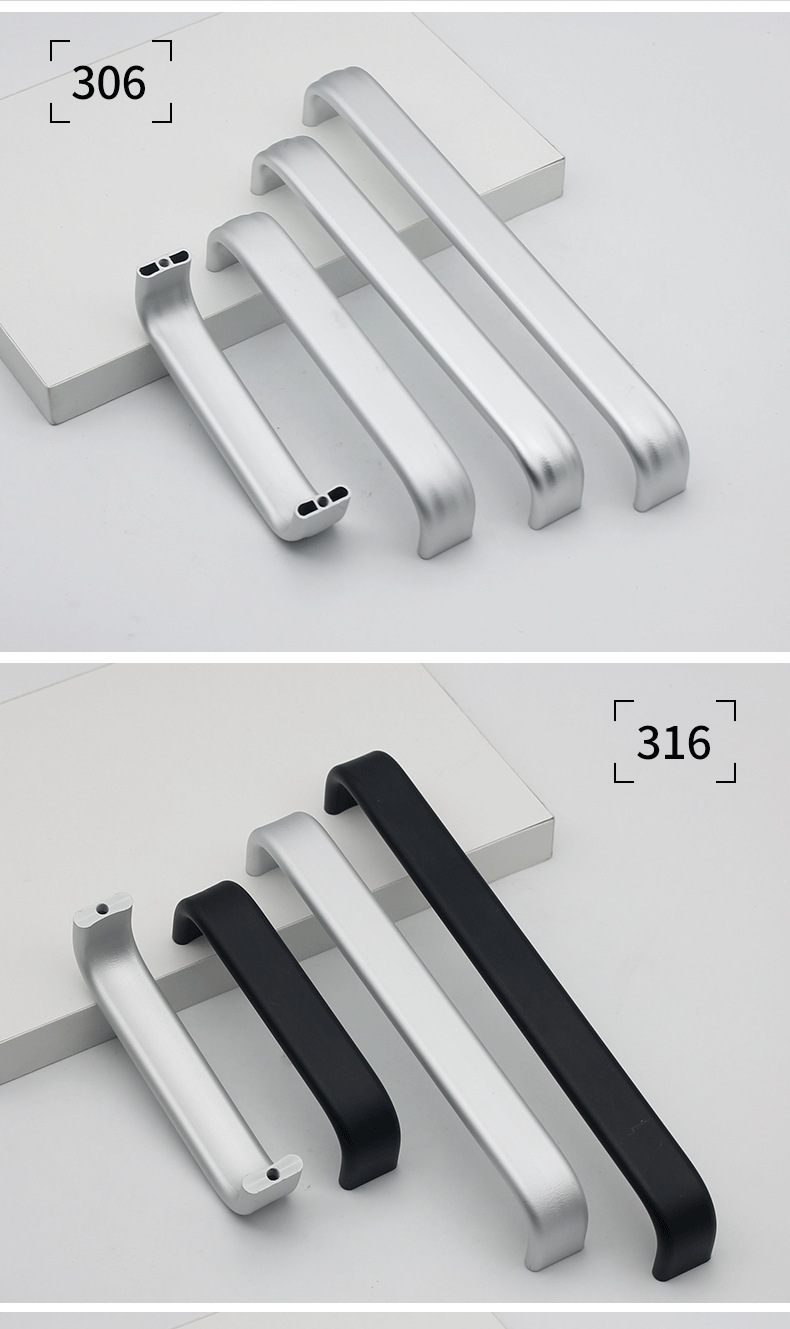
Handles are also the classic “mixed container” product: low weight, small volume, high perceived value. A pallet of handles alongside hinges and slides is one of the simplest ways to lift the average value of a shipment.
Two practical points for handle orders. First, confirm the hole spacing (centres) your market uses — 96, 128, 160, 192 and 224 mm are the common standards, and mixing them up is the most common handle complaint. Second, decide the packing format early: bulk, neutral box or full private-label colour box. Handles are ideal for private label because the tooling cost sits in the mould, not the packing.
Five sourcing shifts to plan for in 2026
- Consolidation. Buyers are reducing the number of suppliers they manage. The winners are suppliers who can quote hinges, slides, drawer boxes and handles from one factory floor — and take responsibility for the whole order. Suppliers who sub-contract across five workshops cannot guarantee one quality standard.
- Quality expectations are rising faster than prices. Soft-close and damped hardware is no longer a premium tier; it is what the market asks for first. In many markets, a basic hinge now has to be soft-close just to make the listing.
- Handleless is mainstream. Push-to-open and concealed hardware are moving from niche to standard in mid-range kitchens. Expect demand for push-to-open fittings to keep climbing through 2027.
- Renovation stays strong. Refresh projects — replacing hinges, slides, handles and baskets rather than whole kitchens — keep demand steady for replacement-friendly products. Every refresh project is, in practice, a hinge-and-slide order.
- Mixed loading wins. Importers increasingly ship mixed containers: several product families combined to cut freight per unit and spread risk across categories. A supplier who can combine categories in one container — and document it correctly — is worth more than a marginally lower unit price.
Quality checkpoints before you commit
Before confirming any volume order, it is worth collecting four things from your supplier:
- Test data — cycle tests for hinges and slides, salt-spray hours for finishes
- Inspection routine — pre-shipment inspection with a stated AQL, plus test reports per batch
- Certification — ISO 9001 at minimum, with CE / RoHS / REACH documentation for the products that need it
- Packaging samples — the shipping carton your customer will actually receive, not just the display box
These four items protect your brand more than any price negotiation. Ask, too, for the pre-shipment inspection standard in writing — AQL 1.5 is a common baseline — and keep a copy of the batch test report on file for each shipment. When a customer question comes a year later, that file is the difference between a data-backed answer and an apology.
Ordering essentials: MOQ, lead time and logistics
Once the product is right, the order itself should hold no surprises. The terms below are the baseline we quote to importers and distributors:
- MOQ. Standard items typically start at 500 pcs per size and finish, with trial orders from 50 pcs so you can verify quality before committing.
- Samples. Ready in 3–7 working days after spec confirmation, shipped by DHL or EMS.
- Lead time. 15–30 days after deposit for regular production; complex OEM orders are quoted individually.
- Payment. 30% deposit by T/T with the balance before shipment is the norm; PayPal or XTransfer for sample orders.
- Packing. Bulk, neutral or private-label cartons, sized and reinforced for mixed loading.
- Documents. Commercial invoice, packing list and certificates (CE / RoHS / REACH where applicable) travel with every order, with Russian and English paperwork available for Central Asia.
Treat these six points as your checklist: a supplier who answers all of them clearly is a supplier you can scale with.
FAQ
What should I check first when comparing hinge suppliers?
Start with the cycle-test count and finish durability, not the unit price. A hinge tested to 100,000 cycles with 72-hour salt-spray protection will generate far fewer field complaints than a cheaper hinge with no test data — and complaints cost more than the price difference.
Which drawer slide should I stock for my market?
In most markets, start with a balanced trio: 3-fold ball-bearing slides as the volume line, undermount soft-close slides for premium kitchen projects, and push-to-open slides for handleless designs. Add heavy-duty full-extension slides if you serve workshop, tool or laundry segments.
Are handleless kitchens just a trend?
No — handleless designs have been growing for a decade and now account for a significant share of mid-range and premium kitchens. Push-to-open slides, tip-on hinges and latches are the hardware that makes the style work, and they are stocked alongside every normal hinge and slide program.
Can I combine hinges, slides and handles in one order?
Yes, and for many importers that is the point: one supplier, one container, one set of documents. Mixed loading lets you spread freight across several product families and test new lines without committing to a full container of a single item.
What is the minimum order for a trial?
Trial orders from 50 pcs per item are typical for standard ranges, so you can verify quality, packaging and logistics before scaling up. OEM items start with a sample, then a first production run agreed per project.
Ready to build your 2026 hinge, drawer and handle program?
WFMingKun Hardware supplies soft-close and heavy-duty hinges, drawer slides, drawer systems, pull-out baskets, handles and knobs — factory-direct from China, with OEM/ODM support, tested batch quality and export packing for distributors, importers and furniture manufacturers.
Browse hinges, drawer slides and handles, or send us your inquiry with your product list — you will get prices, MOQ and lead time within 24 hours. Prefer to talk first? Message us on WhatsApp: +86 187 5400 6560.