
Industry Insights · October 2026
Drawer Slides: A Complete 2026 Buyer’s Guide (Ball-Bearing, Undermount, Heavy-Duty & Push-to-Open)
A cabinet door is opened a few times a day. A drawer moves every time someone reaches for a spoon, a shirt or a screwdriver — dozens of times a day in a busy kitchen, tens of thousands of times over a cabinet’s working life. It is the most-used mechanism in residential furniture, and the one end users judge fastest: a drawer that runs rough tells a customer more about quality than any showroom finish.
For importers, distributors and furniture makers, drawer slides are also one of the steadiest categories in the hardware business. Every kitchen, wardrobe, vanity and office cabinet needs them; they wear and get replaced; and the range of lengths, loads and features means there is always a specification to match a project — from a 400 mm kitchen drawer to a 1000 mm tool-chest rail. This 2026 guide covers the five slide families we supply — ball-bearing, undermount soft-close, heavy-duty, push-to-open and economy two-fold — plus the selection rules, quality checks and ordering details that matter when you compare suppliers.
Start with the drawer, not the slide
The most common sourcing mistake is choosing a slide first and making the drawer fit it. The reliable order is the opposite:
- Load. Estimate the filled drawer weight — not the empty box. Kitchen drawers with pots, workshop drawers with tools and wardrobe drawers with denim all fall into different load classes.
- Length. Match the slide to the nominal drawer length, then confirm cabinet depth. Full-extension slides need clear travel depth behind the drawer.
- Extension type. Full extension opens the whole drawer for access to the back; partial extension (typical of two-section slides) is enough for standard storage at a lower cost.
- Mounting. Side-mount fixes to the cabinet side and the drawer side; undermount hides beneath the drawer box for a clean interior.
- Damping and opening. Soft-close damping, push-to-open release, or plain travel — match to the door and drawer front design.
- Finish. Zinc plating or black are the standard choices; climate and design decide the rest.
Get these six decisions right and any slide in this guide will perform for years. Get them wrong and the best slide on the market will still disappoint — which is why the selection conversation matters more than the unit price.
The five slide families we supply
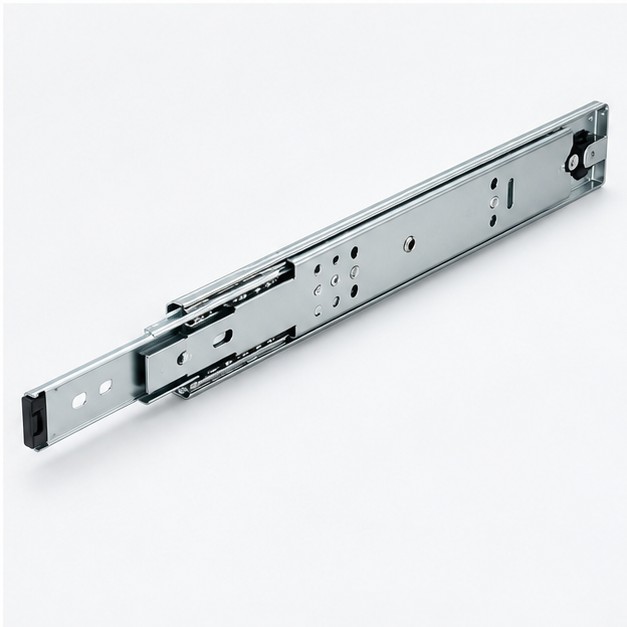
3-Fold Full-Extension Ball-Bearing Drawer Slide
The volume standard for kitchens, wardrobes, office desks and RTA furniture. Three sections, full extension, precision steel balls for smooth and silent travel — lengths from 250 to 600 mm carrying 35–45 kg, in cold-rolled steel with zinc-plated or black finish, packed 10 sets per carton.
If you stock one slide, make it this one: it covers the widest range of everyday drawer sizes, and its specification sheet is the baseline against which buyers compare everything else. Side-mount installation keeps fitting simple across cabinet styles, and the steel-ball movement stays consistent batch after batch.
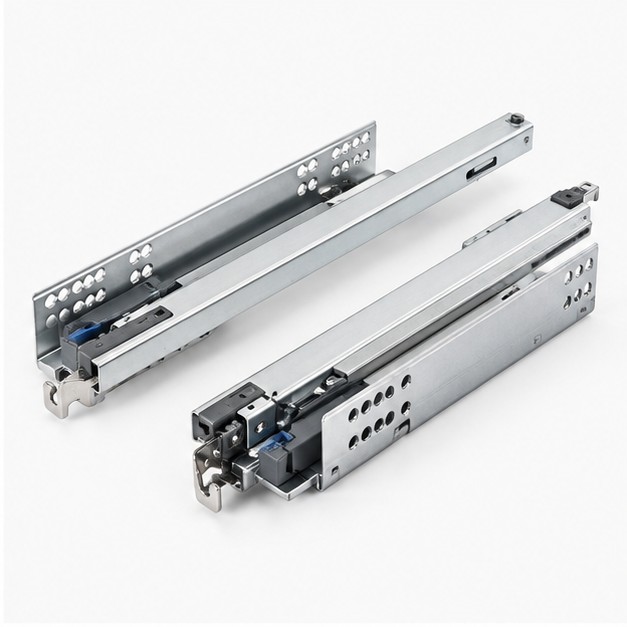
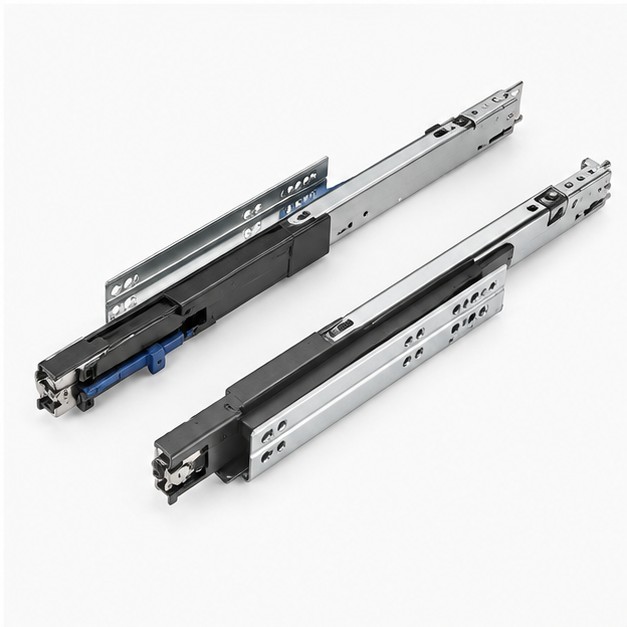
Undermount Soft-Close Full-Extension Drawer Slide
The premium look: the slide fixes beneath the drawer box, so nothing shows on the drawer sides. Three-section full extension, integrated soft-close damping, rear hook and front catch locking — 270–600 mm lengths carrying 30–60 kg. A push-to-open version is available where the configuration allows.
Undermount slides are specification-driven: the drawer box must match the rail, and the rear fixing point must line up with your cabinet. Send the drawer drawing first and confirm the matching before committing to a bulk order — that one step removes most installation surprises.
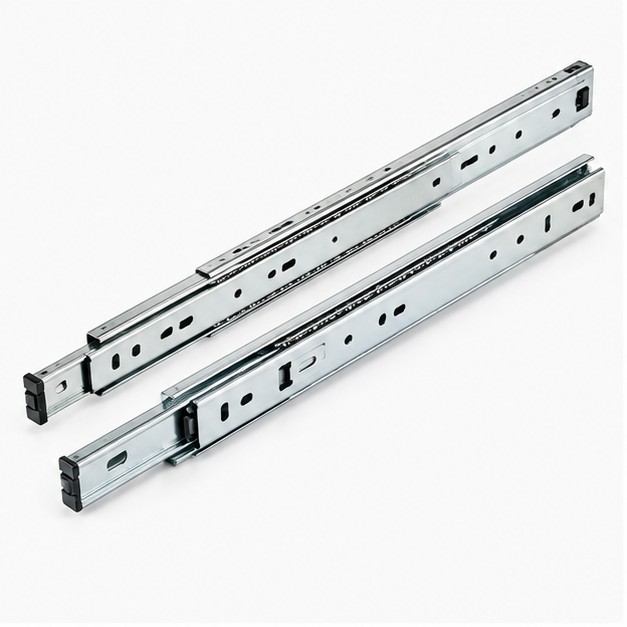
Heavy-Duty 45–100 kg Full-Extension Drawer Slide
For large drawers, tool chests, industrial cabinets and vehicle storage. Lengths run from 300 to 1000 mm with load ratings from 45 up to 100 kg depending on configuration; 1.0–1.2 mm steel and six precision bearings keep travel smooth even fully loaded, in zinc, black or white finish.
Heavy-duty buyers should treat the load rating as a starting point, not a constant: the rating falls as length grows, so confirm the exact SKU against the exact drawer size and payload before you order.
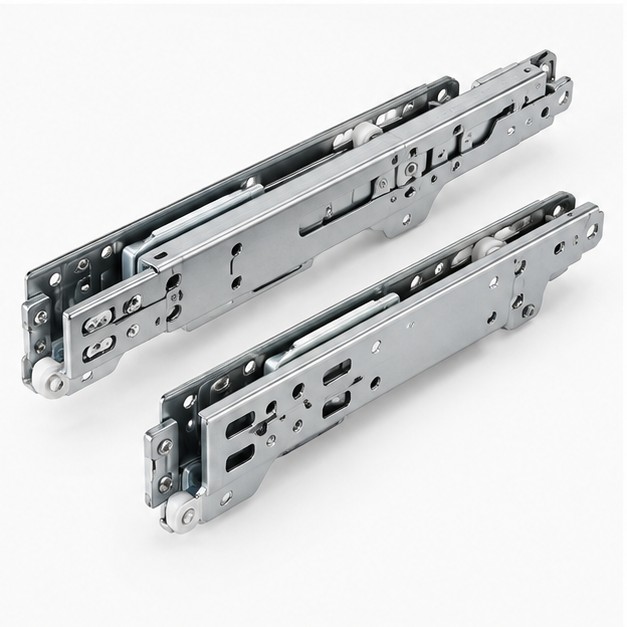
Push-to-Open Full-Extension Drawer Slide
A press on the drawer front releases the mechanism — no pull, no handle, no visible hardware. Lengths from 250 to 500 mm carrying 20–35 kg in cold-rolled steel, zinc or black finish. Designed for handleless drawers in modern kitchens, vanities and hotel furniture.
The one critical number: the installed weight of the drawer front. Match the release force to the front weight and test with the actual front fitted — a mismatched front is the most common cause of “sticky” push-to-open complaints. Order a sample pair early, while the front design is still moving.
Two-Fold Side-Mount Economy Drawer Slide
A two-section, side-mount slide for standard drawers where full extension is not required. Lengths of 200–500 mm in 35/45 mm widths, 20–30 kg per pair, SPCC steel with bearing balls, zinc-plated or black electrophoresis, packed 20 sets per carton.
This is the economy line that makes bedroom sets, office furniture and economy retail ranges price properly — without the end customer noticing “cheap”. Keep it to standard-access drawers and it will earn its shelf space.
The lengths that move
Across all five ranges, demand concentrates on a handful of sizes. For kitchen work, 350, 400, 450 and 500 mm 3-fold slides cover most base cabinets, with 550–600 mm for deep pan drawers. Wardrobes usually run 400–500 mm; office and workshop drawers climb to 600–1000 mm, where the heavy-duty range takes over. Undermount drawers add one constraint — the rail must match both the drawer box and the cabinet depth — so confirm the pair (box plus rail), not the rail alone. If you keep stock in only one place, make it a short run of lengths in each family: two or three sizes in a single finish will fit most projects, while special sizes stay a production order rather than an inventory decision.
How to read a slide spec sheet
Spec sheets across suppliers look similar; the numbers inside them are where projects succeed or fail. Six fields decide:
Length. Slides are ordered by nominal length in set increments (250, 300, 350 mm and so on, up to 1000 mm depending on the family). “Drawer length plus 10–20 mm clearance” is the working rule; the final check is against your drawer drawing and cabinet depth. Full-extension models also need clear travel behind the drawer — measure it before you promise the fit.
Load rating. Ratings are per pair and configuration-specific: 20–30 kg for economy two-fold, 35–45 kg for ball-bearing, 30–60 kg for undermount, and 45–100 kg for heavy-duty full-extension. Design to the worst case and keep a margin, especially for drawers that get leaned on or pulled sideways.
Extension. Three-section slides extend fully; two-section slides do not. If the user needs to reach the back of the drawer — cutlery, tools, the lost lid — do not compromise on this point.
Mounting. Side-mount slides fix to the cabinet side, so the rail is visible inside the cabinet. Undermount slides hide beneath the box and demand tighter box tolerances. Both are common across Europe, the Middle East and Central Asia; confirm what your market actually installs before you stock deep.
Damping. Soft-close is now the baseline expectation in mid-market kitchens. Push-to-open belongs to handleless fronts. Neither should be specified by habit — specify by front design.
Finish. Zinc plating and black cover most demand. In coastal or humid destinations, confirm the coating system for the exact component and ask what the reorder will look like from the same production line.
Quality checks that separate suppliers
- Cycle testing. Slides in our program are cycle-tested to 50,000+ open-close cycles as per the current specification. Ask for the test basis of the exact model, not the catalogue family.
- Ball cage and travel. Run a sample pair by hand: rough travel, noise or a gritty feel means the cage or ball grade is not stable. This hand test finds more real problems than any data sheet.
- Steel gauge. Slide strength lives in steel thickness (1.0–1.2 mm on heavy-duty lines). A supplier who cannot state the gauge is selling a look, not a mechanism.
- Coating. Rust at the mounting holes is the first failure point in humid markets. Confirm the plating on the exact component, edges included.
- Packaging. Bulk packing is usually 10 sets per carton (slide lines) or 20 sets per carton (economy). Export carton quality decides whether your container arrives straight or with bent rails.
- Batch consistency. Reorders must ship from the same tooling as the approved sample. Ask the question before the second order, not after.
Pair slides with drawer systems
Slides rarely ship alone. The drawers that sell best in 2026 are part of a system: a metal drawer box set with rails and clips included, an aluminum drawer profile for custom widths, an under-sink pull-out basket with soft-close slides, or an adjustable organizer insert that turns a plain drawer into a cutlery system.
For importers, selling the system lifts average order value and cuts compatibility complaints: slides, boxes and pull-outs arrive specified to work together. For kitchen projects, the difference between “a drawer” and “a storage program” is exactly this level of detail.
Five mistakes to avoid
- Measuring the opening instead of the drawer. Slides are matched to drawer boxes and nominal lengths; the opening is a different number.
- Choosing length first. Load and use case decide the family; length is the last filter, not the first.
- Underestimating filled weight. A 60 cm kitchen drawer with plates can pass 25 kg — beyond the comfort zone of economy slides.
- Ignoring front weight on push-to-open. The release mechanism is tuned to a weight window; a heavy front on a light-tension slide will not open cleanly.
- Accepting mixed batches on reorders. Rails that differ by fractions of a millimetre across shipments cost more in installation time than any unit-price saving.
What this means for importers in 2026-2027
Three directions are visible in the orders we see. Handleless design continues its move from premium kitchens into mainstream projects, which keeps push-to-open slides and concealed hardware in demand. Renovation and replacement stay stronger than new build in most export markets, favouring standard-length slides that fit existing cabinets. And buyers keep consolidating: one supplier quoting slides, boxes and pull-outs together removes several purchase orders’ worth of administration from every project.
Standard terms for the category: MOQ from 500 pcs per size and finish, trial quantities from 50 pcs for most items, samples in 3–7 working days, bulk production in 15–30 days after deposit, and mixed-container loading to keep freight efficient across the whole order.
FAQ
How do I choose between side-mount and undermount slides?
Side-mount is easier to fit and standard in most RTA furniture; undermount hides the rail for a premium interior but needs tighter drawer-box tolerances and a matched box. Follow what the cabinet was designed for.
What load can a drawer slide carry?
It depends on the family and configuration: 20–30 kg per pair for economy two-fold slides, 35–45 kg for 3-fold ball-bearing, 30–60 kg for undermount soft-close, and 45–100 kg for heavy-duty full-extension. Always ask for the rating of the exact SKU.
Are push-to-open slides suitable for kitchens?
Yes — they are designed for handleless fronts. Match the slide to the installed front weight (20–35 kg range) and test the release with the actual front fitted.
Can you supply slides together with drawer boxes?
Yes. Metal drawer boxes, aluminium profiles, pull-out baskets and organizer inserts can ship as matched sets with the slides, including in mixed containers.
Ready to build your drawer slide program for 2027?
WFMingKun Hardware supplies ball-bearing, undermount soft-close, heavy-duty and push-to-open drawer slides alongside hinges, drawer systems, handles and connectors — factory-sourced from partner factories in China, with tested batches, OEM/ODM support and export packing for distributors, importers and furniture makers.
Browse drawer slides and drawer systems, or send us your inquiry with your product list — you will get prices, MOQ and lead time within 24 hours. Prefer to talk first? Message us on WhatsApp: +86 187 5400 6560.