Industry Insights · October 2026
Wardrobe Hardware Guide 2026: Hinges, Rails, Drawers & Handles for Closet Production
A wardrobe works harder than it looks. Twice a day someone swings its doors, pulls its drawers and slides hangers along its rails — quiet, repetitive use that either holds up for a decade or announces its weakness in the first month. For the trade, that makes wardrobe hardware one of the most dependable parts of the category: every closet needs hinges, rails, handles and often drawers; every element wears, wears out, and gets replaced.
This 2026 guide walks through the wardrobe from the outside in — door systems, hinge families, interior rails and drawers, handles and the small fittings that finish the job — plus the selection rules, quality checks and ordering details that matter when you compare suppliers. It follows the same approach as our drawer slide guide and hinge, drawer & handle guide: specify the function first, then the part.
Doors first: three wardrobe door systems
Wardrobe hardware conversations should start at the door, because the door type decides the hinge family, the frame load and the clearances inside.
- Hinged doors. The classic wardrobe — a wooden or MDF door on concealed cup hinges. Soft-close damping is the baseline expectation in mid-market projects; handleless fronts move to push-to-open hardware. Confirm door weight, thickness and overlay before choosing.
- Aluminium-frame doors. Slim aluminium profiles with glass or panels, popular in modern kitchens and wardrobes. They use a dedicated aluminium-frame hinge family, built around the profile section — a standard cup hinge forced onto a narrow aluminium frame is one of the most common specification errors we see.
- Sliding and folding doors. Their track carries the door weight, but the hardware around them still matters: interior clearances, edge profiles and catches, plus bumpers that keep closing quiet.
The interior plan comes next. Long hanging, short hanging and shelves decide how many rails a wardrobe needs; drawers and organizers decide what happens below the rail. Sketch the internal elevations before you spec a single hinge — the hardware list falls out of the drawing.
Choosing hinges for wardrobe doors
Aluminium-frame hinges: one family, six layouts
Modern wardrobe production leans on aluminium frames, and the hinge series for them covers six structurally different layouts. They are separate mechanisms, not cosmetic variants of the same part — which is why our aluminium-frame hinge range is documented by frame condition:
- 175° drill-free hinge — a clip-style fixing that avoids drilling into the profile, with a wide 175° opening for easy access across modern doors. Send the profile drawing; clip compatibility is confirmed against it. See the 175° drill-free hinge.
- 165° hinge — wide / medium / straight arm — three arm configurations that match different frame sections and overlay conditions on aluminium kitchen and wardrobe doors, in drill-free or screw-fix versions. See the 165° range.
- 90° hinge — compact geometry for the specific profile layouts where a 90° movement is required, with square or round head options. See the 90° hinge.
- 45° hinge — angled geometry for corner and angled door configurations where a straight hinge cannot deliver the opening. See the 45° hinge.
- Short-arm hinge — a slim profile for narrow frames and tight gaps, where a standard arm would interfere. See the short-arm hinge.
- -45° inward-offset hinge — a reverse-angle relationship between door and frame for specialized designs; the inward offset is structural and cannot be substituted by a standard part. See the -45° hinge.
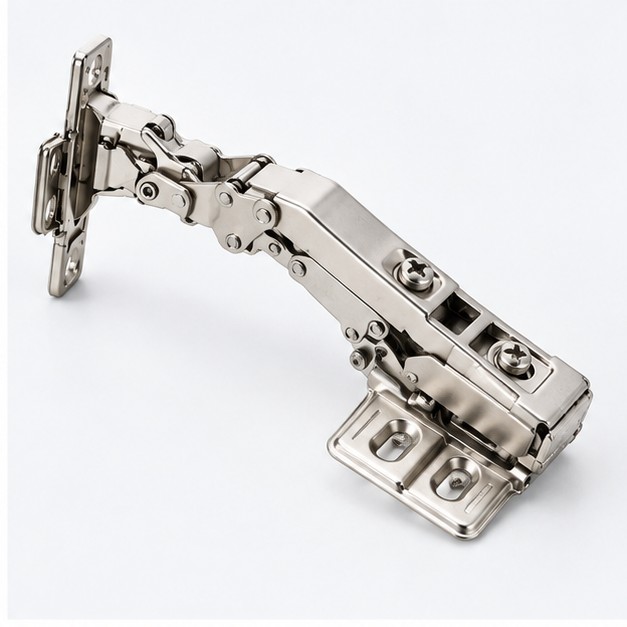
The rule for all six: the profile section drawing decides the arm type and fixing, and mixing arms changes how the door sits. We verify against a sample or drawing before production — never by assumption.
Wooden doors: soft-close and hydraulic hinges
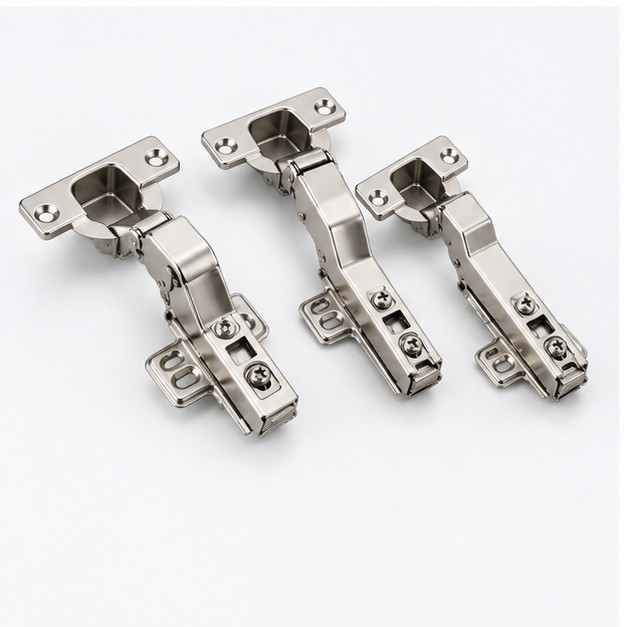
For wooden and MDF wardrobe doors, concealed cup hinges remain the workhorse. The 110° concealed soft-close hinge brings built-in hydraulic damping for quiet closing, in SPCC steel or 304 stainless with 35 mm cups. Where a wider swing or a different damping feel is wanted, the 105°/120° hydraulic hinge covers clip-on and screw-on bases. Handleless wardrobe fronts run on push-to-open tip-on hinges with adjustable press force.
Heavier doors and glass panels
When a wardrobe door is heavy enough that cup hinges are not the right answer, heavy-duty 304 stainless butt hinges carry up to 40 kg per pair in 4×3 in and 5×3.5 in sizes. For display sections and glass-fronted wardrobe units, the clamp-on glass hinge grips 4–8 mm glass without drilling — protective pads hold the panel without marking it.
Inside the wardrobe: rails, drawers and organizers
Clothes rails
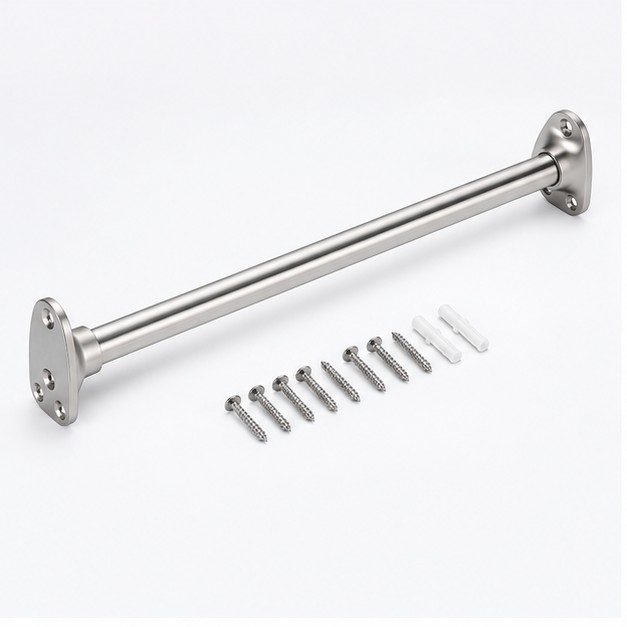
The simplest line and one of the strongest repeaters: a wardrobe clothes rail with mounting flanges — rod plus two flanges, Ø16/19/25 mm, aluminium or stainless, lengths cut to 300–1200 mm. Diameter follows the span and the load: Ø16/19 mm suits standard home wardrobes, Ø25 mm takes heavier hanging and longer spans. Aluminium keeps weight and cost down; stainless suits humid destinations.
Drawers below the rail
Wardrobe drawers live or die by their slides. Hidden undermount soft-close slides give the premium interior — nothing shows on the drawer sides, damping is integrated, and 270–600 mm lengths carry 30–60 kg. For standard drawers, 3-fold ball-bearing slides are the volume choice. Above the slide, the drawer body can come as a matched metal drawer box set (rails and clips included) or a custom aluminium profile system for non-standard widths.
Organizers and pull-outs
Storage below the hanging sells: drawer organizer inserts in PS, bamboo or ABS turn a plain drawer into a wardrobe accessory, with dividers sized for the 300–600 mm drawer widths common across bedroom furniture.
Handles: proportion is everything on tall doors
On a 2.2-metre wardrobe door, a 128 mm handle disappears. That is why wardrobe ranges lean on long pulls:
- Full-height aluminium handles, produced from 500 to 1200 mm in 6063-T5 aluminium with anodised, powder-coated or brushed finishes — matched to the door height for a clean vertical line.
- Aluminum T-bar handles on the 32 mm pitch grid and U-shape pulls in 32/64/128 mm pitches cover the standard-door volume in silver, black and bronze.
- Single-hole round knobs and zinc alloy knobs finish small doors, side units and drawer fronts across chrome, matte black and antique finishes.
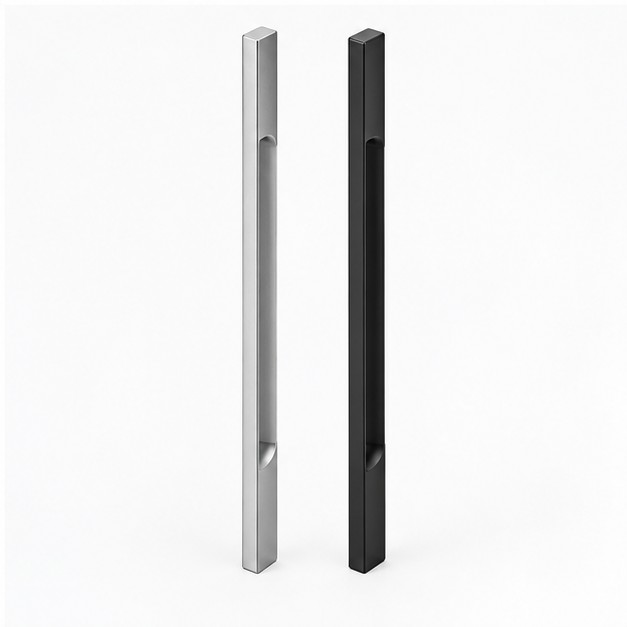
Two practical notes: longer handles for thicker doors need longer screws (tell us the door thickness), and handles for tall doors should be specified with the drilling positions agreed before production, not at installation.
Small fittings that finish a wardrobe
The last five percent of a wardrobe is the part users notice most:
- Push-to-open latches — 30–50 N adjustable release for handleless doors, clip-on or screw-fixed, with a magnetic option where confirmed.
- Magnetic catches — 2–5 kg pull for secondary doors and light panels that only need to stay closed, in screw or adhesive mounting.
- Door bumpers — self-adhesive TPE or silicone pads that silence closing and protect surfaces, Ø10–20 mm, packed 500 per box.
Specify them while the door design is open — retrofitting soft-close and catches after the hardware list is frozen is how projects ship with rattles.
Quality checks that protect a wardrobe programme
- Cycle-test basis. Ask for the test standard of the exact model, not the catalogue family. Our soft-close hinges are cycle-tested to 100,000+ open-close cycles and tip-on mechanisms to 50,000+ as per current specifications.
- Frame fit. Clip a sample hinge onto the actual profile section. Clip tension, arm clearance and plate seating must all feel right; one sample door beats ten spec sheets.
- Rail strength. Check rod diameter against span and flange fixing with a real load test — rails fail by sag, not by looks.
- Coating and edges. Rust starts at holes and cut edges in humid destinations; confirm the plating on the exact component.
- Packaging. Hinges ship 100 pcs per carton; rails need profile protection to arrive unscratched; drawer sets 5 or 10 per export carton. Carton quality decides how the container arrives.
- Batch consistency. Reorders must come from the same tooling as the approved sample — raise it before the second order, not after.
Sizing and specification rules that prevent returns
- Door weight per hinge count. Confirm the hinge rating for your door weight and increase hinge count on heavier doors, or move to a butt-hinge layout.
- Profile section for frame hinges. Arm type, fixing method and head type are confirmed from the drawing — the six layouts are not interchangeable.
- Rail diameter vs span. Standard home spans use Ø16/19 mm; go to Ø25 mm for heavier loads and longer runs.
- Drawer pairing. Undermount slides need a matched drawer box; confirm box + rail together, not the rail alone.
- Handle pitch and door thickness. Measure the existing drilling pitch (32/64/128 mm grids) and state the door thickness for screw lengths.
- Front weight on push-to-open. Release forces are tuned to weight windows — 20–35 kg on slides, 30–50 N on latches, 5–8 N on tip-on hinges.
Five mistakes to avoid
- Treating aluminium-frame hinges as one product. The six layouts differ structurally; choose by profile, not by price.
- Forcing standard cup hinges onto narrow aluminium frames.
- Buying rails on price per metre instead of diameter and fixing — sagging rails generate returns that unit price never covers.
- Skipping the drawer-box pairing on undermount slides.
- Specifying push-to-open hardware without the installed front weight.
What this means for importers in 2026–2027
Three directions stand out in the orders we see. Slim aluminium frames and handleless fronts keep expanding from premium projects into mainstream wardrobes, pulling the whole aluminium-frame hinge range and push-to-open fittings with them. Storage upgrades inside the wardrobe — extra drawers, organizers, better rails — outperform new-build in renovation-heavy markets, which favours standard sizes and matched sets. And buyers keep consolidating: one supplier quoting hinges, rails, drawer systems and handles together removes several purchase orders from every project.
Standard terms for the category: MOQ from 500 pcs per size and finish, trial quantities from 50 pcs on most items, samples in 3–7 working days, bulk production in 15–30 days after deposit, and mixed-container loading to keep freight efficient across the order.
FAQ
Which hinges fit aluminium-frame wardrobe doors?
The aluminium-frame family covers six layouts — 175° drill-free, 165° wide/medium/straight arm, 90°, 45°, short-arm and -45° inward-offset. The correct one depends on the profile section and door layout; send a profile drawing or door sample photo and we will confirm the arm type and fixing.
How do I choose a wardrobe rail diameter and length?
Ø16/19 mm suits standard home wardrobes; Ø25 mm is for heavier hanging and longer spans. Lengths run 300–1200 mm, cut to order, and every set ships with two mounting flanges.
Can I use the same drawer slides in wardrobes as in kitchens?
Yes — undermount soft-close slides give the premium hidden look and standard 3-fold ball-bearing slides cover volume drawers. Confirm the drawer length, box height and cabinet depth; matching metal or aluminium drawer boxes are available as sets.
What are the standard MOQ and sample terms?
MOQ from 500 pcs per size and finish with trial orders from 50 pcs on most items; samples in 3–7 working days; bulk production 15–30 days after deposit; mixed containers supported.
Ready to build your wardrobe hardware programme for 2026–2027?
WFMingKun Hardware supplies aluminium-frame hinges, soft-close hinges, rails, drawer systems, handles and finishing fittings — factory-sourced from partner factories in China, with tested batches, OEM/ODM support and export packing for distributors, importers and furniture makers.
Browse hinges, drawer systems and handles, or send us your inquiry with your product list — you will get prices, MOQ and lead time within 24 hours. Prefer to talk first? Message us on WhatsApp: +86 187 5400 6560.