
Industry Insights · October 2026
Furniture Brackets & Shelf Supports Guide 2026: Shelf Brackets, Angle Brackets & Support Legs
Brackets and supports are the parts nobody photographs and everybody depends on. A shelf bracket holds a span of books; an angle bracket squares a cabinet corner; a support leg carries the base cabinet while a leveling foot quietly compensates for an uneven floor. When one of them is specified badly, the failure is never quiet — shelves sag, joints loosen, plinths crack.
For the trade, this is one of the most honest categories in the hardware business: the numbers are simple (load, span, thickness), the demand is steady across shelving, kitchen, wardrobe and shop-fit projects, and buyers who get the load right come back for the same sizes again and again. This 2026 guide covers the bracket and support families we supply — heavy-duty shelf brackets, L-type angle brackets and adjustable support legs — plus the load, material and fixing rules that keep projects standing. It follows the same approach as our other sourcing guides: specify the function first, then the part.
Start with the load, then the shape
Three questions decide a bracket specification before style matters.
- What must it carry? A display shelf and a workshop shelf look identical in a photo and differ by an order of magnitude in load. Estimate the filled weight (books, tools, crockery) and design to the worst case — plus a sensible margin.
- Over what span? Bracket length follows shelf depth; the number of brackets follows the span and the load. Wide spans with few brackets is where sagging starts.
- Fixed to what? The substrate decides the fixing: timber studs, masonry, concrete or cabinet panels all take different screws and anchors. A bracket rated for 60 kg per pair means nothing if the wall fixing gives way first.
Answer those and the family falls out naturally: heavy-duty shelf brackets for spanning, angle brackets for joining, support legs for carrying. Browse the whole range in our brackets & supports category.
The bracket and support families we supply
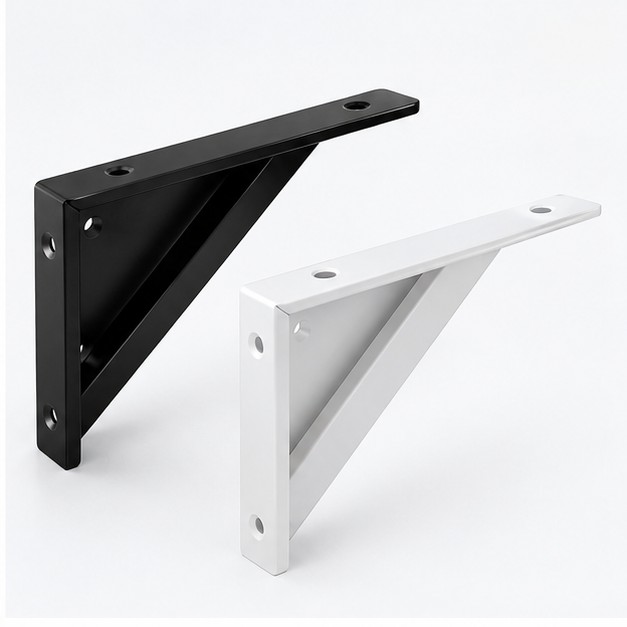
Heavy-Duty Steel Shelf Bracket
The workhorse of shelving: 2.5 mm cold-rolled steel with white or black powder coating, in sizes from 100 to 300 mm and load ratings of 30–60 kg per pair depending on size. Screws are included, and packing runs 100 pairs per carton.
The 2.5 mm gauge is what separates a bracket that holds from a bracket that bends: it survives overloads, resists vibration on workshop walls, and keeps shelf lines straight years after installation. Match size to shelf depth — deeper shelves need longer brackets and more fixing points. View the heavy-duty shelf bracket.
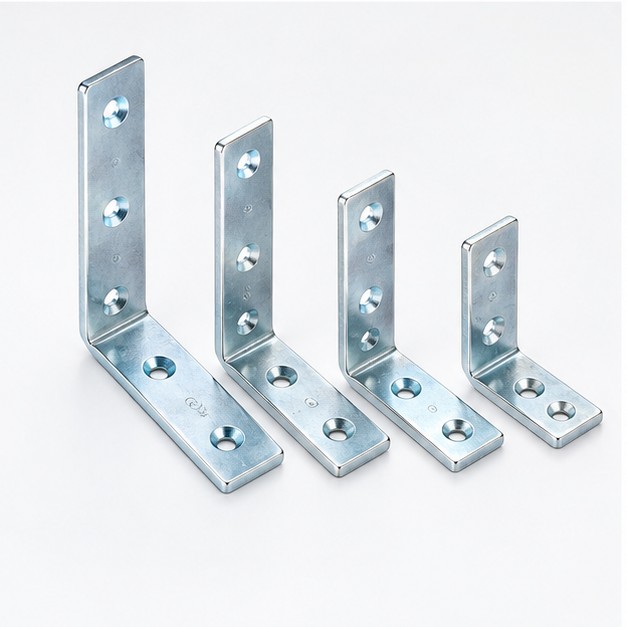
L-Type Furniture Angle Bracket
The joint-maker: an L-profile with pre-drilled countersunk holes for flush screw seating, in sizes from 40×40 to 100×100 mm, in steel or stainless steel with zinc or black finishes. Countersunk holes matter more than buyers expect — a flat-head screw that sits flush lets panels close fully and looks finished rather than improvised.
Use angle brackets to square corners, reinforce cabinet carcasses, repair furniture and build shelving frames. Keep a size ladder in stock, because jobs rarely need one size only. View the L-type angle bracket.
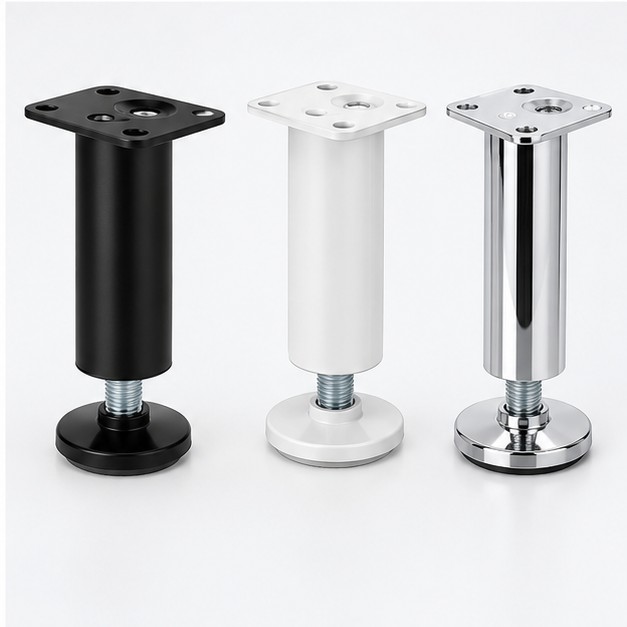
Adjustable Furniture Support Leg
The quiet hero under kitchen and vanity cabinets: heights from 60 to 200 mm, steel or aluminum, black, white or chrome, with an adjustable leveling foot and a load rating of 80–150 kg per leg. The leveling foot is the feature that saves installations — a few millimetres of thread adjustment turns an uneven floor from a problem into a routine step.
Legs are sold as a system: distribute them per cabinet weight and confirm the plinth height before ordering. View the furniture support leg.
Custom Brackets, Stamped to Drawing
When a project needs a bracket that does not exist yet — a specific hole pattern, an angled profile, a powder-coated colour — custom stamping takes over: SPCC or SUS304 steel from 0.5 to 4.0 mm, zinc plating or powder coat, tooling developed per drawing. View custom stamped metal brackets.
Load, span and fixing: the numbers that matter
- Per pair, not per bracket. Bracket ratings are quoted per pair because shelves are held by pairs. When you add brackets to a wide shelf, treat each pair’s share of the load — not the shelf total — as the number to design against.
- Span decides count. Wider spans need more brackets. As a working rule, add fixing points as the span grows and the load climbs; the drawing, not the habit, should set the count.
- Length follows shelf depth. 100–300 mm brackets cover the shelf depths most shelving uses; deep shelves that carry books want the longer end of the range.
- Substrate sets the fixing. Timber studs take construction screws; masonry needs plugs and anchors matched to the hole; drywall alone is never a structural fixing. Confirm substrate before quoting the load to an end customer.
- Legs share the weight. With ratings of 80–150 kg per leg, four legs on a base cabinet provide a multiple of the cabinet’s working load — distribute them near corners, not evenly across a span, and adjust the leveling feet after loading.
- Countersunk means flush. On angle brackets, confirm the countersink matches the screw head you ship — mismatches show up as proud heads and panels that will not close.
Materials and finishes by market
- Zinc-plated steel is the indoor default: economical, corrosion-resistant enough for dry interiors, and a good base for further coating.
- Powder coating (white / black) covers the visible brackets — shelf brackets and legs where colour is part of the design.
- Stainless steel (SUS304) is for humid and coastal markets, wet rooms and exterior-adjacent shelving; pair it with stainless screws, because mixed metals corrode faster than either alone.
- Finish at edges and holes. Coating wear starts at cut edges and fixing holes; when approving a sample, look there first, then at the colour.
- Climate note. For humid destinations, state the market when ordering so the finish system — not just the colour name — is matched to the environment.
- Ask for the standard, not the number. Salt-spray results get quoted as hours; ask which standard and which item was tested — a number without a standard is marketing, not data.
Quality checks for bracket orders
- Gauge check. Measure the steel: 2.5 mm on shelf brackets is a specification, not a suggestion. Calipers on a sample beat any catalogue claim.
- Forming and welds. Look for sharp burrs, uneven bends and weld spatter — they scratch hands, shelves and finish.
- Countersink quality. Test a screw in the hole: it should seat flush without forcing and without spinning.
- Load test. Clamp a bracket pair and load it — progressively — with real weights. This is the test that matters, and it takes minutes.
- Leg thread and leveling. Run the foot through its adjustment range: smooth thread, no wobble, full travel.
- Packing. Brackets ship 100 pairs per carton, legs 4 pcs per carton; export cartons must protect powder-coated surfaces, because touch-ups at the destination cost more than the packaging ever will.
- Batch consistency. Same gauge, same hole pattern, same finish sheen on reorders — raise it before the second order.
Comparing bracket quotations
Two bracket quotations rarely compare directly. Before comparing prices, line the offers up on six points: gauge, measured not claimed — 0.1 mm on a 2.5 mm bracket is a 4% material difference; finish system — “white” can mean zinc, or zinc plus powder; screw inclusion — some quotes exclude the screws your customer will ask for; packing — bulk, polybag or retail-ready; quantity tier — the 500-piece price and the 5,000-piece price are different offers; and Incoterm — FOB and EXW quotes are different products wearing the same description. Payment terms belong on the list too: 30% deposit is the category norm, but compare when the balance falls due — “after loading” and “against B/L copy” are different cash flows. Put the six lines side by side, and the cheapest quote is rarely the cheapest purchase.
Installing for strength
Installation follows three habits: fix into structure (studs, masonry, or through-bolted panels — never drywall alone); keep brackets on the same level line before loading; and load shelves from the wall outwards while checking alignment. For furniture legs, level the cabinet before the worktop goes on, then fine-adjust after loading — and leave a small adjustment margin in the plinth design, because floors are rarely as flat as drawings.
Fix by wall type: timber studs take construction screws driven into the stud, never into plaster alone; brick and block take plugs matched to the drilled hole; concrete takes sleeve anchors; plasterboard over battens means finding the batten or adding one — a hollow-wall plug is for pictures, not for shelving. The wall carries the shelf load too, so when the substrate is uncertain, over-specify the fixing rather than the bracket.
Stocking logic for distributors
Brackets reward a simple matrix: a size ladder (100/150/200/250/300 mm), two colours (white/black), pair-packed with screws, plus one stainless option for humid markets. Angle brackets follow the same discipline — 40×40 through 100×100 covers joints across furniture, shelving and repair work. Legs stock best in two or three heights with one finish family. For importers, brackets are a classic basket-builder: low unit price, universal demand, and they ride along with every shelving or kitchen order.
Five mistakes to avoid
- Quoting a load rating without the span and substrate.
- Fixing to drywall alone and calling it structural.
- Mixing steel brackets with the wrong screw material in humid markets.
- Choosing gauge by price instead of the specification.
- Specifying legs without a leveling margin in the plinth.
What this means for importers in 2026–2027
Three directions stand out. Shelving and storage keep expanding in renovation-heavy markets, which keeps standard brackets and angle brackets moving. Kitchen and vanity manufacturers keep standardising on adjustable legs with leveling feet, because they simplify installation on real floors. And buyers keep consolidating: brackets and supports from the same supplier as hinges, slides and connectors keep finishes matched and cut purchase orders per project.
Standard terms for the category: MOQ from 500 pcs per size and finish, trial quantities from 50 on most items, samples in 3–7 working days, bulk production in 15–30 days after deposit, and mixed-container loading to keep freight efficient across the order.
FAQ
How do I choose the right bracket size and load?
Match bracket length to shelf depth (100–300 mm covers most shelving), then choose the rating by the load the shelf must carry — 30–60 kg per pair depending on size. Confirm the span and substrate with us and we will match the exact bracket.
Can these brackets be used in humid or coastal markets?
Yes — choose stainless steel (SUS304) options and stainless screws for humid environments, and confirm the finish system on the exact item. State the destination climate when ordering so finishes are matched to the market.
How many support legs does a cabinet need?
With 80–150 kg per leg, four legs cover the vast majority of base cabinets; distribute them near corners and fine-tune the leveling feet after loading. Share the cabinet size and weight for a recommendation.
What are the MOQ and packing terms?
MOQ from 500 pcs per size and finish, trial quantities from 50 on most items. Packing: 100 pairs per carton (shelf brackets), 4 pcs per carton (legs), 500 pcs per carton (angle brackets). Samples in 3–7 working days; bulk production 15–30 days after deposit.
Ready to build your bracket and support programme for 2026–2027?
WFMingKun Hardware supplies heavy-duty shelf brackets, L-type angle brackets, adjustable support legs and custom stamped parts — factory-sourced from partner factories in China, with tested batches, OEM/ODM support and export packing for distributors, importers and furniture makers.
Browse brackets & supports, or send us your inquiry with your product list — you will get prices, MOQ and lead time within 24 hours. Prefer to talk first? Message us on WhatsApp: +86 187 5400 6560.