
Industry Insights · October 2026
Cabinet Handles & Knobs Guide 2026: T-Bar, U-Shape, Full-Height Pulls & Knobs
Handles are the first hardware anyone touches. Before a buyer notices hinge quality or drawer glide, their hand closes around a pull — and that single interaction carries an outsized share of the perceived quality of a kitchen, wardrobe or piece of furniture. For the trade, handles are also one of the friendliest categories in the hardware business: modest unit prices, huge variety, and steady replacement demand across every market.
This 2026 guide covers the handle families we supply — aluminium T-bar handles, U-shape pulls, full-height wardrobe handles and the knob range — plus the pitch, screw and finish rules that prevent returns, the quality checks worth running, and the stocking logic that makes handles pay. It follows the same approach as our drawer slide guide, wardrobe hardware guide and furniture connectors guide: specify the function first, then the part.
Start with the door, the hand and the pitch
Three questions decide 90% of handle specifications before style enters the picture.
- The door. Door thickness sets screw length; door material sets the fixing method (single-hole knob, two-hole pull, or a full-height handle on a tall door). For glass or aluminium-frame doors, confirm the fixing points first — some frames need specific standoff lengths.
- The hand. Pull style follows the opening effort and the ergonomics of the space: below a wall cabinet a T-bar or thin profile reads clean; under a drawer bank, a pull with a comfortable grip matters more. On tall doors the hand travels further and reaches lower — which is why full-height handles exist.
- The pitch. Hole centres — the pitch — are the one number no photograph can communicate. Measure the existing drilling centres (or fix your production drilling to the standard grids: 32 mm for knobs and pull feet, 64/96/128/160 mm for pulls) and treat that grid as fixed across the whole catalogue.
Get those three right and any handle in this guide drops into place. Get the pitch wrong and every other property becomes irrelevant. Browse the full range in our handles & knobs category.
The handle families we supply
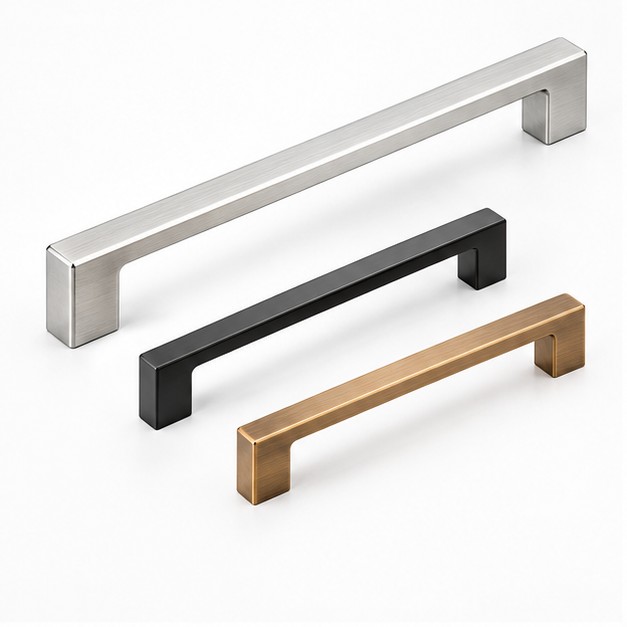
Aluminum T-Bar Handle
The clean-lined volume standard for kitchens and wardrobes. Aluminium alloy with anodized or powder-coated finishes — silver, black and bronze — in lengths from 96 to 224 mm (96/128/160/192/224 mm) on the standard 32 mm hole pitch. M4 screws are included, with longer screws available for thick doors.
The T-bar’s consistent profile thickness is what separates a good run from a cheap one: it should feel solid without being heavy, and the same profile should arrive identically across reorders. View the aluminum T-bar handle.
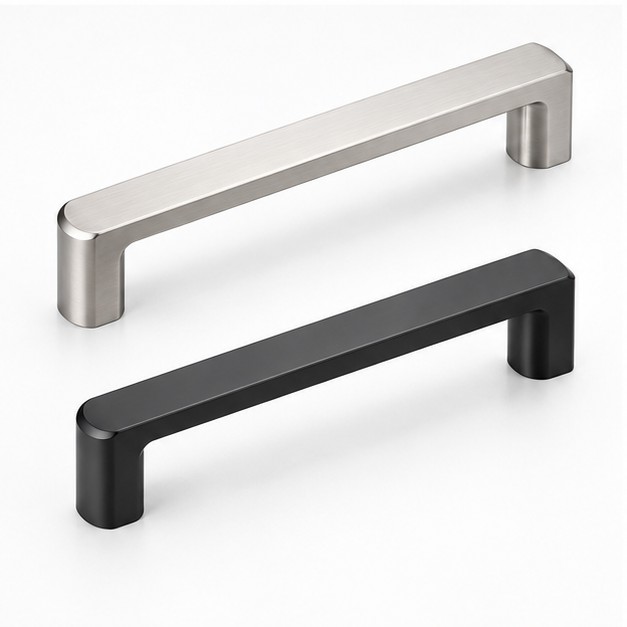
U-Shape Cabinet Pull
A modern profile in zinc alloy or stainless steel, with brushed and matte black finishes, supplied with standoffs and end caps fitted. Lengths run 64–160 mm across 32/64/128 mm pitches — the combination that covers drawer fronts, cabinet doors and furniture panels in most catalogues.
Specify zinc alloy for standard indoor furniture and stainless where humidity or heavier use is expected; both take the same mounting pattern, so switching family later does not change the drilling. View the U-shape cabinet pull.
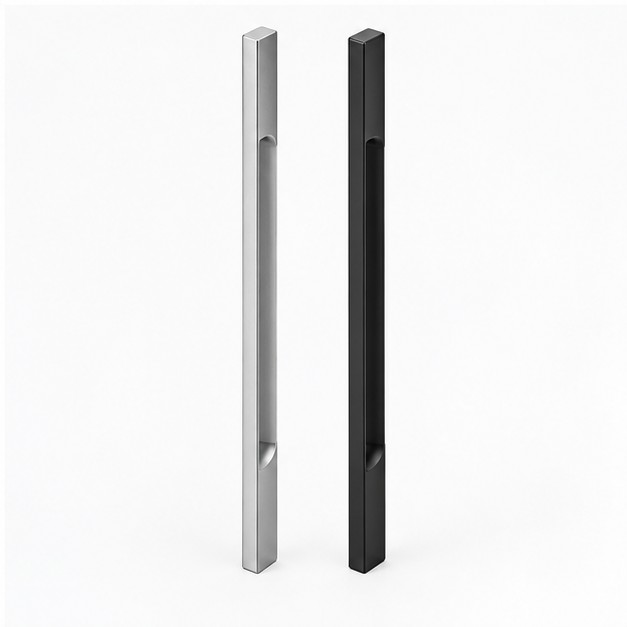
Full-Height Aluminum Handle
The tall-door specialist: a 6063-T5 aluminium profile produced from 500 to 1200 mm, in anodized, powder-coated or brushed finishes. It replaces a pair of small pulls on wardrobe doors with one continuous vertical line — the detail that makes modern wardrobes look designed rather than assembled.
Because these handles are cut to order, share the door height and drilling positions so the length, fixing points and packaging are confirmed before production. View the full-height aluminum handle.
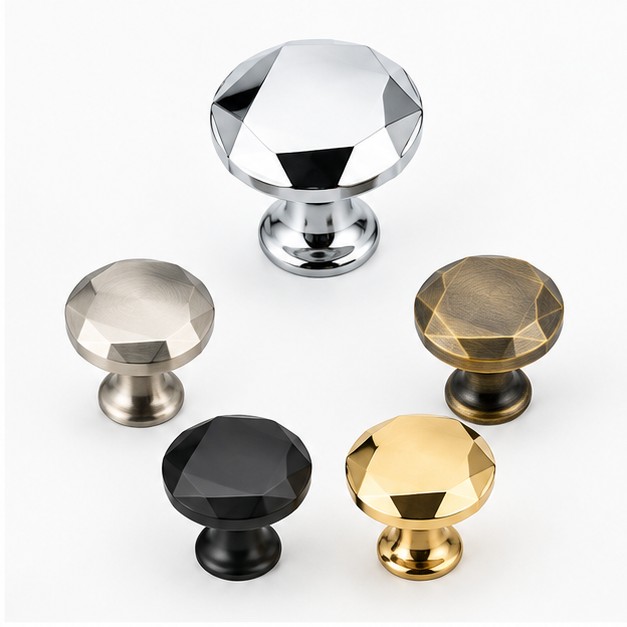
Round Knobs & Zinc-Alloy Knobs
For small doors, side units and drawer fronts, the knob range covers single-hole round knobs (Ø15–40 mm in zinc alloy, crystal, ceramic or aluminium depending on the model) and classic zinc-alloy knobs in 25/30/35 mm with chrome, nickel, antique, gold and matte black finishes.
One hole per knob keeps drilling simple — which is exactly why knobs remain the default on economical and retrofit furniture. View the single-hole round knob and the zinc alloy cabinet knob.
Knob or pull — a quick rule
Use knobs on small doors, light drawers and places where one finger does the work; use pulls where the hand needs grip — larger doors, deep drawers, pull-out baskets and anywhere wet hands open the cabinet. Mixed programmes are normal: knobs for drawer fronts and small doors, pulls for tall fronts. Keep the finish family consistent across both, and the choice stops being visible — which is the goal.
Pitch, screws and thickness: the details that cause returns
- Measure, don’t guess. Pitch is centre-to-centre distance between fixing holes. On retrofits, measure the existing holes before choosing; on new production, fix the drilling grid (32 mm family) and keep it stable.
- Screw length follows door thickness. Standard screws suit standard doors; thick or double-skin doors need longer screws — state the thickness when ordering so lengths are matched at the factory, not on site.
- Single-hole knobs need one clean bore. A knob that spins is usually a drilled hole problem, not a knob problem — confirm bore diameter for the fixing hardware supplied.
- Standoffs are part of the design. On U-shape pulls and round-bar handles, standoffs hold the profile clear of the door face and protect fingers; check they arrive fitted and matched to the bat length.
- Batch consistency. Reorders must match the approved sample in profile thickness, finish tone and screw threads — handle runs are assembled by eye, and eyes notice drift.
- Retrofit kits. The replacement market buys by matching: pitch, standoff height and screw length. Counter sets that pair a common pitch with the commonest finishes turn a one-off repair into a stocked line.
- Glass and aluminium doors. Confirm fixing points on the frame section — some profiles need specific standoff lengths or through-fixing hardware. Send the profile drawing and the fixing is confirmed before production.
Finish selection by market
Finish is where handle programmes win or lose shelf space, and where climate matters:
- Anodized silver and black cover most modern interiors and hold their look in daily wear.
- Powder-coated colours (including bronze) extend the palette; confirm against a physical sample for tone, not a screen.
- Matte black keeps expanding across kitchens and wardrobes — it hides fingerprints and photographs well, which keeps selling.
- Brass, antique and gold carry classic and transitional ranges, often paired with matching knobs.
- Humid and coastal markets: confirm the finish system on the exact item (anodizing or plating quality), not just the colour name. Ask the supplier to state the finish basis for the item you are ordering.
- Physical samples first. Screens flatter every finish; sunlight does not. Approve tone from a physical sample before bulk.
Quality checks that protect a handle programme
- Wall thickness and rigidity. Flex a pull by hand: a hollow, springy profile will deform on the door. This ten-second test beats any specification sheet.
- Finish at the edges and threads. Worn plating starts at ends, holes and standoff threads; check them first.
- Pitch and drilling template. Verify a sample against the drawing: hole spacing, standoff height, end cap fit.
- Screws included and correct. M4 and standard screws should arrive in the bag; confirm thread engagement in the pull feet with the supplied screws.
- Packaging. Handles scratch in transit; individual wrapping and export carton quality decide what your customers open.
- Batch consistency. Same tooling, same finish process, same paper trail from the approved sample onwards.
Stocking logic that makes handles pay
Handles reward a disciplined matrix. Pick a small grid — one or two profiles per style family, lengths at the commonest pitches, two or three finishes — and let special sizes stay production orders. In practice, three to five “hero” SKUs per family — the pitch and finish combinations most projects use — carry the stock; everything else runs on demand. Two habits sharpen it further: keep screw bags matched to the handles they ship with, and pair knob ranges that share finishes with the pulls, so a customer ordering “matte black everything” gets one visual language. For importers, handles are also the easiest add-on line: light to ship, simple to stock, and every furniture programme needs them in volume.
One more lever for distributors: sample boards. A compact board showing profiles and finishes at real scale sells more than any catalogue page — buyers understand pitch and thickness in ten seconds when the parts are in their hands.
Custom and OEM handle programmes
Beyond the standard range, handle programmes take three custom shapes: lengths cut or extruded to your door sizes (full-height handles already ship 500–1200 mm to order), finishes matched to your catalogue (powder colours, anodized tones, antique effects), and packaging under your own brand — polybag, blister or display box with your label.
The workflow is straightforward: send a drawing or a reference sample with the target quantity, and we confirm the profile, finish basis and packing before production. Two practical notes: freeze the pitch grid with the drawing so accessories stay compatible, and approve finishes from physical samples — photo approvals age badly, sample approvals hold.
Five mistakes to avoid
- Ordering from photos alone — pitch and profile thickness are invisible in a picture.
- Mixing pitches (or drilling grids) within one catalogue.
- Forgetting door thickness when ordering screws.
- Choosing ultra-thin profiles that flex on larger doors.
- Letting finishes drift across reorders while marketing the range as a matched set.
What this means for importers in 2026–2027
Two directions stand out. Handle design keeps moving with the door: slim aluminium profiles and matte black finishes for modern fronts, full-height pulls for tall wardrobes, brushed and antique finishes for classic ranges. And renovation demand keeps replacement orders flowing — retrofit buyers measure old holes, so a supplier who quotes by pitch (not by photo) wins the reorder. Consolidation still pays: handles, hinges and slides from one supplier keep finishes and mounting patterns consistent across a whole project.
Standard terms for the category: MOQ from 500 pcs per item and colour, mixed colours within one order welcome, samples in 3–7 working days, bulk production in 15–30 days after deposit, and mixed-container loading to keep freight efficient across the order.
FAQ
How do I choose the right hole pitch for handles?
Measure the existing centre-to-centre hole distance (or fix your production drilling to the standard 32 mm grid; pulls commonly use 64/96/128/160 mm). Send the measurement or drawing and we confirm the matching lengths.
Which handle length suits which door?
Small drawers and side units take short pulls and knobs; standard cabinet doors take T-bar or U-shape pulls at the common pitches; tall wardrobe doors suit full-height handles (500–1200 mm) for a continuous line.
Which finish should I stock for humid markets?
Confirm the finish system on the exact item — anodizing for aluminium profiles, plating quality for zinc and steel. State the destination climate when ordering so finishes are matched to the market.
What are the MOQ and packing terms?
MOQ from 500 pcs per item and colour with mixed colours in one order; standard screws included; samples in 3–7 working days; bulk production 15–30 days after deposit; mixed containers supported.
Ready to build your handle programme for 2026–2027?
WFMingKun Hardware supplies aluminium T-bar handles, U-shape pulls, full-height wardrobe handles, knobs and matching screws — factory-sourced from partner factories in China, with tested batches, OEM/ODM support and export packing for distributors, importers and furniture makers.
Browse handles & knobs, or send us your inquiry with your product list — you will get prices, MOQ and lead time within 24 hours. Prefer to talk first? Message us on WhatsApp: +86 187 5400 6560.